Electrifying a Dutch Factory with Thermal Energy Storage
Can you electrify a factory in the Netherlands and actually make money? We modeled it three ways in the Entropic platform. This is what came out.
€2.2M saved per year compared to the gas baseline | 6.4 yr simple payback on a €14.0M hybrid investment | −74 / −100% natural gas reduction, hybrid / fully electric |
The question
Every project developer, energy company and consultant in the Netherlands is asking the same question right now: does electrifying a factory pay off, or do you still need gas? Most answers today come from gut feeling or from a consultancy report with 30-50% accuracy on costs. But modelling it properly is what is needed to find the best case. In this case study I will show three industrial energy systems we optimized, then the data inputs we used, and finally the results and comparison and what I think they mean.
The factory is a chips factory with 49 GWh of process heat and 15 GWh of electricity demand per year. Today all heat comes from a 20 MW gas boiler. We compared that baseline against a hybrid system (solar, battery, e-heater and a 40 MWh thermal storage, with the gas boiler as backup) and a fully electric system with no gas connection at all. Every system was sized and dispatched by our optimization engine, hour by hour against real market prices, always on the lowest TCO.
The short version of the result: the hybrid saves €2.2 million per year against the baseline and €13.2 million over 20 years, with a payback of 6.4 years. Fully electric also clearly beats gas (€1.9 million per year, €9.4 million lifetime) but stays €3.8 million behind the hybrid. Gas is harder to defend in some areas of the world than most people think, even keeping the boiler around is mainly useful as a backup for expensive power hours.
The scenarios — three ways to power the same factory
We built each system in the drag-and-drop system builder from the same demand profiles and let the optimizer size everything. The diagrams come straight from the platform.
Scenario 1: Baseline — gas boiler and grid
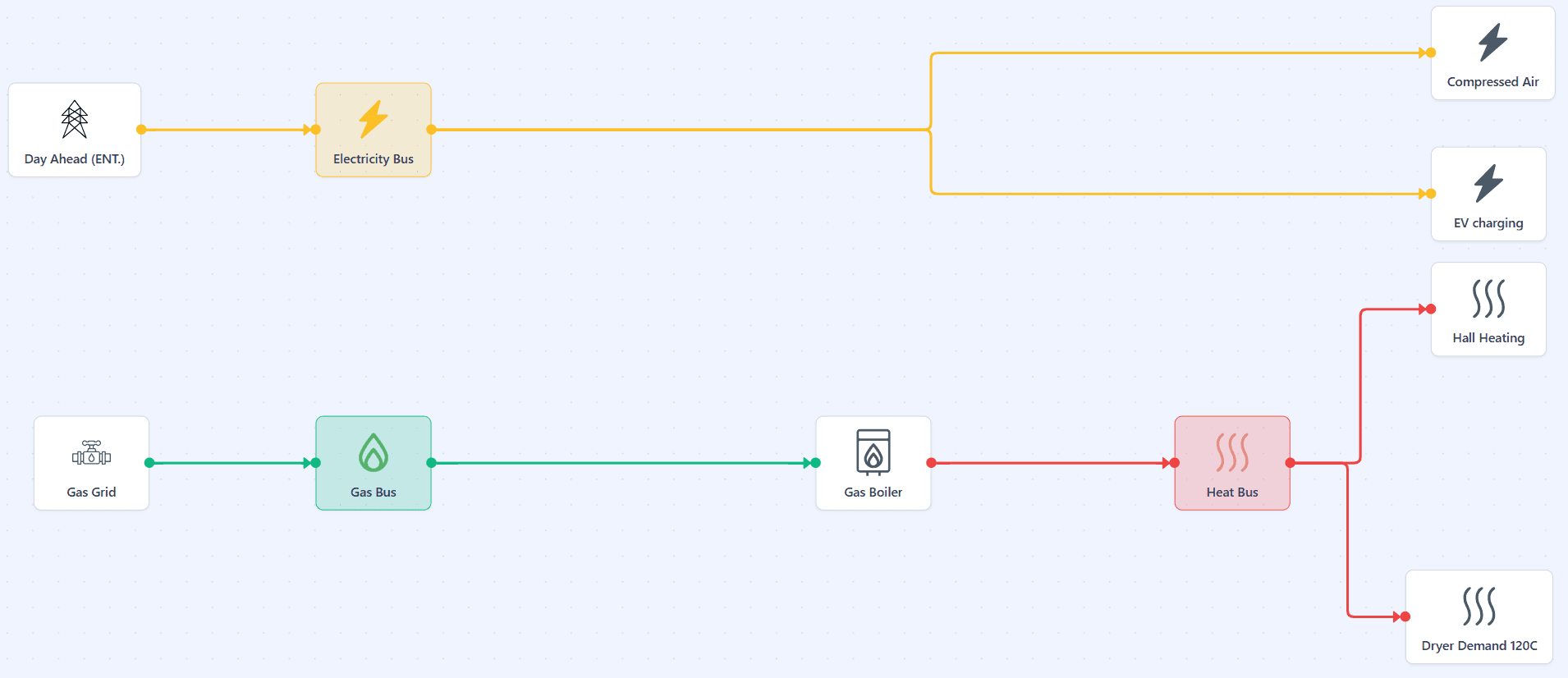
The reference. A 20 MW gas boiler makes all the heat, the grid covers compressed air and EV charging. No investment needed, but you buy 51.5 GWh of gas per year and you are fully exposed to the gas price.
Scenario 2: Hybrid — PV, battery, e-heater and TES, gas as backup
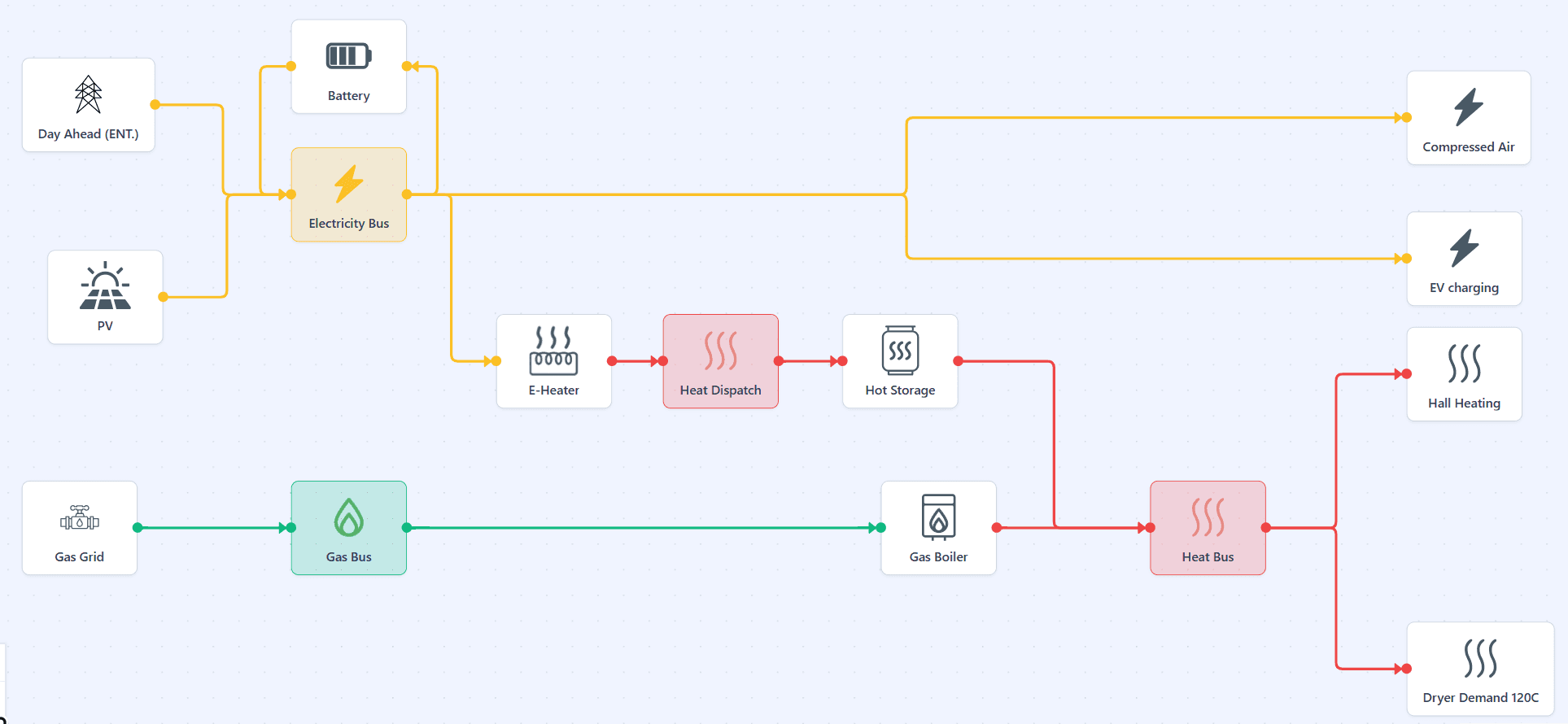
A 16.0 MWp solar park, a 2.0 MWh battery and a 10 MW e-heater charge a 40 MWh thermal storage when power is cheap or the sun shines. The gas boiler only runs when gas is genuinely cheaper. Gas use drops 74% and the average power purchase price falls from €87 to €59 per MWh.
Scenario 3: Fully electric — no gas connection
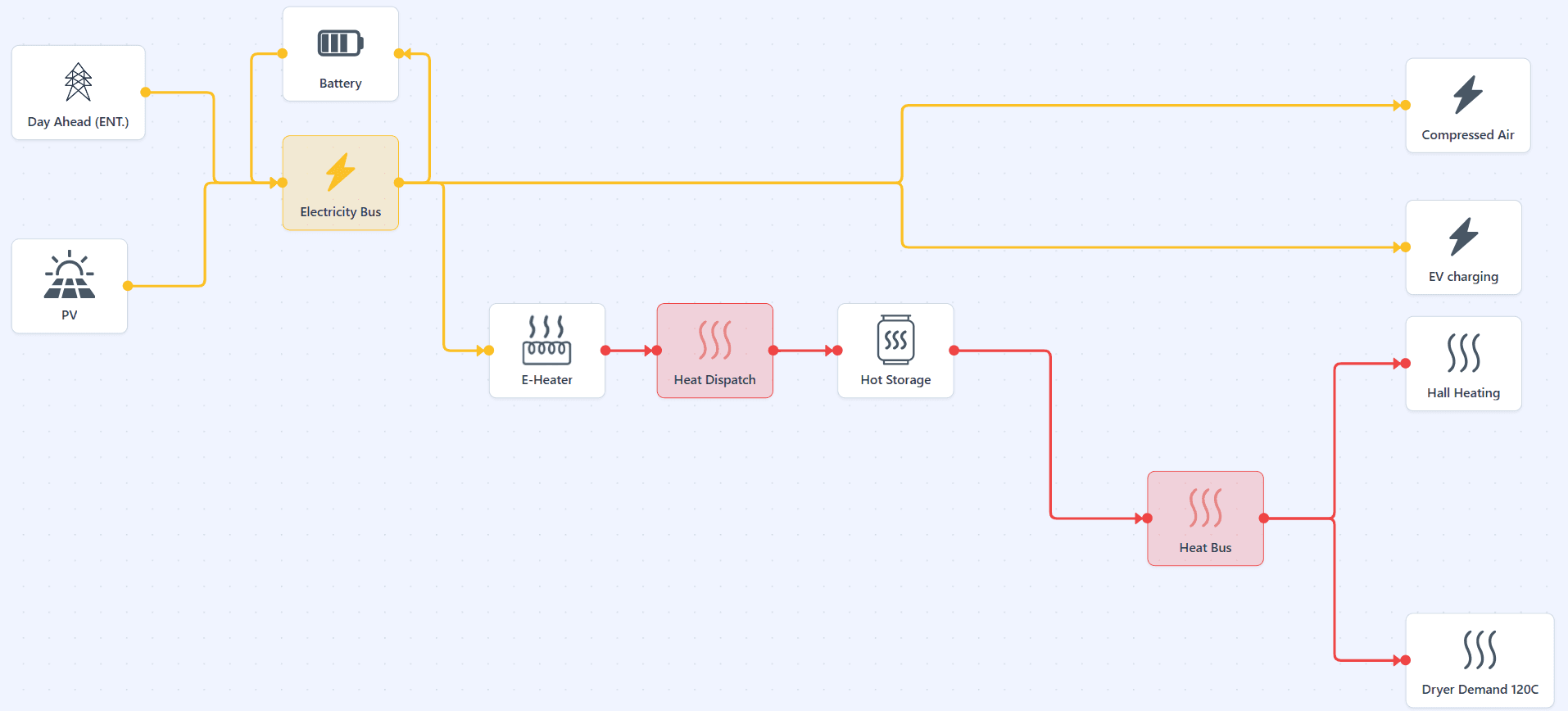
The solar park grows to 16.9 MWp and the e-heater plus TES take over all heat supply. No gas connection anymore. The factory runs on 59.9 GWh of electricity per year, 29% of it produced on site.
Data inputs — the data we used
Every number below is an input you can check and change. The electricity prices come from ENTSO-E, the solar profile comes from PVGIS combined with the project location (this is built into our software), and the demand profiles were generated inside the platform, including a thermodynamic calculation of the dryer’s energy use.
Input | Value and basis |
|---|---|
Electricity price | Hourly Dutch day-ahead market prices from ENTSO-E, full-year profile |
Solar generation | PVGIS solar data plus project location, built into the platform — 1,024 kWh per kWp per year |
Demand profiles | Generated with the platform’s demand generator; dryer energy use calculated with the thermodynamics tools in the app |
Natural gas price | €60 per MWh, flat |
PV investment | €460 per kWp installed (Lazard / European utility-scale benchmarks) |
Battery investment | €320 per kWh installed, turnkey |
Thermal energy storage | €150 per kWh-th — 40 MWh-th capacity, 10 MW charge and discharge |
E-heater | 10 MW-th, operating credit of €30 per MWh-th applied in dispatch |
Factory demand | Process heat (dryer) 38.9 GWh-th; hall heating 10.0 GWh-th; compressed air 5.0 GWh-e; EV charging 2.4 GWh-e per year |
Financial parameters | 5% discount rate, 20-year project horizon, no subsidies included |
IN THE ENTROPIC PLATFORM — FLEXIBLE DATA INPUTS Generating profiles should be easy. We made this accessible by building it all into the platform: generate demand profiles with the demand generator, run thermodynamics calculations directly in the app (that is how we calculated the energy use of the dryer), pull solar production from PVGIS based on your project location, upload your own measured profiles, or simply use a constant load. |
IN THE ENTROPIC PLATFORM — DATABASES FOR PRICING Pricing is where business cases get time consuming and can go wrong. Entropic users have access to our pricing library. Hourly electricity prices from ENTSO-E, grid tariffs of local operators and technology cost benchmarks (PV, battery, thermal storage) are all available in the platform and kept up to date. You can use them as they are, or override any number with your own quotes when you have real supplier prices. |
IN THE PLATFORM — SCENARIOS AS TEMPLATES Every system built in Entropic can be saved as reusable templates, including the pricing mechanisms and subsidy schemes. For the next factory you load the template and update the demand data. Never rebuild energy systems again! |
Results — the comparison
Metric | Baseline | Hybrid | Fully electric |
|---|---|---|---|
Natural gas use | 51.5 GWh/yr | 13.6 GWh/yr | — |
Electricity use | 7.4 GWh/yr | 46.3 GWh/yr | 59.9 GWh/yr |
Of which: on-site PV | — | 16.4 GWh/yr | 17.4 GWh/yr |
Avg. electricity purchase price | €87/MWh | €59/MWh | €76/MWh |
Annual energy cost (OPEX) | €3.73M | €1.55M | €1.82M |
Investment (CAPEX) | — | €14.0M | €14.5M |
Total cost of ownership, 20 yr (NPV) | €46.5M | €33.3M | €37.1M |
Levelized cost of energy | 6.6 ct/kWh | 4.8 ct/kWh | 5.3 ct/kWh |
Annual savings vs baseline | — | €2.18M | €1.92M |
Simple payback | — | 6.4 years | 7.6 years |
The hybrid wins clearly. The reason is flexibility. The thermal storage lets the optimizer buy electricity in the cheapest hours and keep the gas boiler for the moments gas is genuinely cheaper. That is why the hybrid pays €59 per MWh for electricity on average while the baseline pays €87 on the same market. The fully electric system has to buy power in all hours, also the expensive ones (€76 average), and still ends €9.4 million below the baseline over 20 years. But the numbers say keeping the gas boiler as backup is worth €3.8 million: you only run it for 13.6 GWh per year, and it saves you the most expensive power hours. The open question is what happens when gas prices move. At €60 per MWh gas keeps this small role, above that the fully electric case takes over. That is exactly the kind of sensitivity you can test in the platform in minutes.
IN THE PLATFORM — OPTIMIZATION ON TOTAL COST OF OWNERSHIP The optimization engine sizes every asset (PV, battery, TES, e-heater) and dispatches the full system hour by hour against real market prices, always minimizing total cost of ownership. So the result is always the most cost effective system that the input data allows. |
From concept to investment decision with confidence
Coming back to the goal: we want Entropic to be the standard for renewable energy project development. That means every assumption explicit, every scenario reproducible, and results you can put in front of an investment committee. This whole study, three complete systems sized and optimized hour by hour, was built in the platform in hours, not the weeks it normally takes in excel.
Want to run this analysis on your own project?
www.entropic.energy · melchiorkrijgsman@entropic-energy.com